

There are forms of exhaustion that don’t leave visible evidence.
No dramatic breakdown. No overflowing calendar. No obvious crisis. Just a constant feeling of being mentally “on”, even during moments that are technically meant to feel restful.
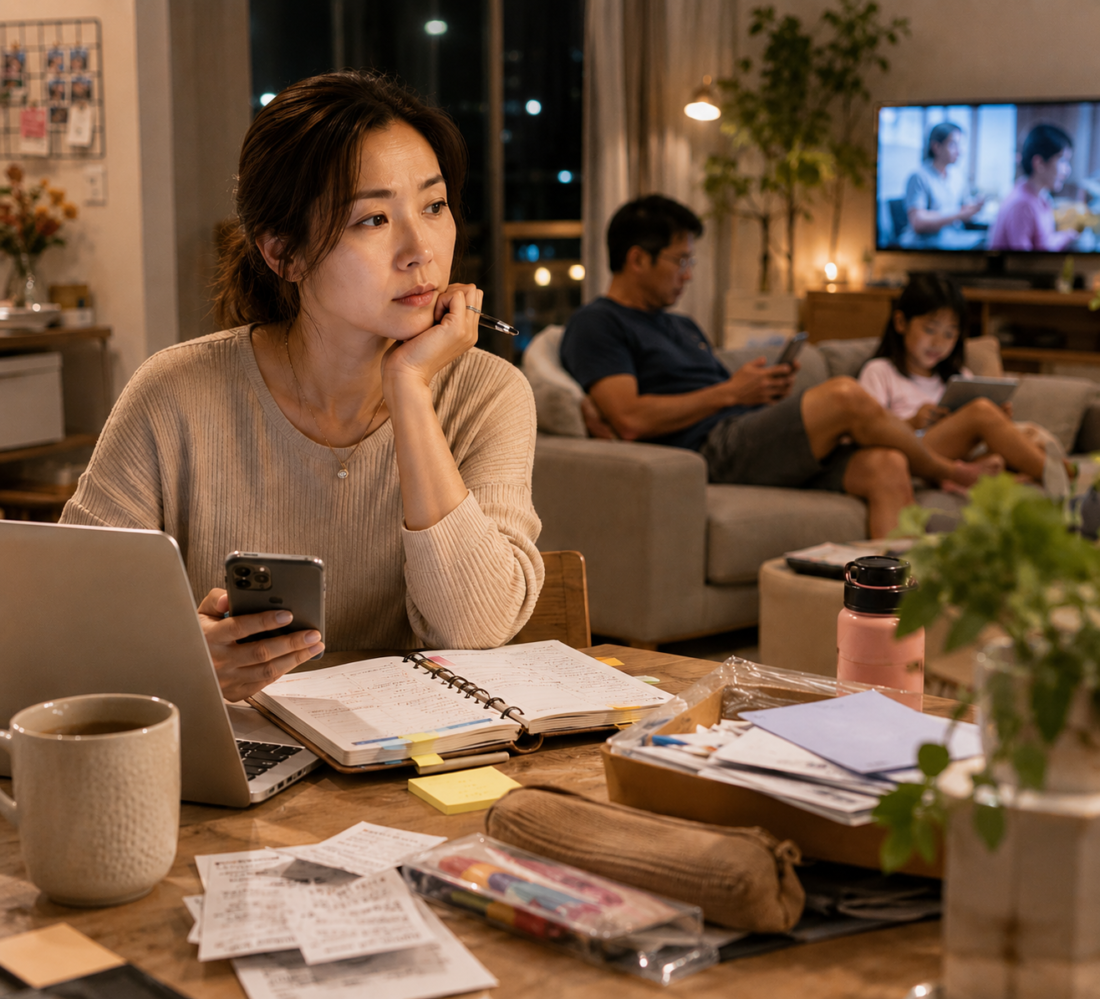
You answer messages while thinking about dinner. You’re listening to someone talk while mentally tracking appointments, groceries, deadlines or whether the laundry was left damp in the washing machine. You remember birthdays, emotional sensitivities, medication timings, school notices, unpaid bills, where the passports are, and what still needs to be done next week.
Eventually, your body begins responding as though it never truly gets to stand down.
For many people, this is what the mental load actually feels like. Not necessarily physical labour, but invisible cognitive and emotional labour that quietly runs in the background all day long.
It often goes unnoticed precisely because it looks manageable from the outside.
You may still be functioning. Still replying emails. Still showing up to work. Still cooking dinner. Still smiling during social gatherings. But internally, your nervous system may already be operating in a near-constant state of anticipation and alertness.

The Exhaustion That Comes From Constant Mental “On” Mode
Modern life rewards visible productivity, but it rarely acknowledges invisible responsibility.
People notice the presentation you delivered, but not the mental effort it took to remember everyone’s schedules before you even sat down to work. They see the organised birthday party, but not the dozens of tiny decisions, emotional calculations and contingency planning happening quietly behind the scenes.
And while motherhood is often central to conversations around invisible labour, emotional load extends far beyond parenting alone.
Caregivers managing ageing parents. Adult children coordinating medical appointments. Partners who become emotional anchors in relationships. Employees constantly absorbing workplace tension. Friends who quietly become the “responsible one” in every social group.
Even people living alone can experience overwhelming emotional labour through the constant burden of self-management and survival in an increasingly demanding world.
The exhaustion often comes less from one major task and more from relentless mental accumulation.
Remembering. Anticipating. Monitoring. Coordinating. Adjusting.
Over time, this creates a form of cognitive occupation where the brain rarely feels fully at rest.
Many people begin noticing signs that their body is running on stress hormones instead of energy before they realise how much invisible emotional labour they are carrying.
The body often recognises overload earlier than the mind does.
Sleep becomes less restorative. Patience shortens. Small inconveniences suddenly feel disproportionately overwhelming. Even moments of rest can feel mentally crowded because part of the brain remains responsible for anticipating what could go wrong next.
This is one reason why so many people struggle to fully switch off during weekends, holidays or evenings at home. Their bodies may technically be resting, but their nervous systems remain partially activated.
Why Invisible Labour Feels So Hard To Explain
One of the hardest parts about the mental load is that it is difficult to prove.
There is no productivity tracker for emotional monitoring. No obvious benchmark for anticipatory stress. No visible checklist showing who remembered the school forms, noticed someone’s emotional shift, tracked household supplies, scheduled the appointments or mentally planned the week ahead.
And because invisible labour often happens silently, people carrying it may struggle to explain why they feel so exhausted.
This is also why phrases such as “Just ask for help” can sometimes feel strangely incomplete.
Because the exhaustion is not always about physically doing everything alone. Often, it is about being the person constantly responsible for noticing, remembering and mentally holding everything together in the first place.
Delegating a task may still require someone to mentally track the task.
Asking for help may still require emotional energy, planning and explanation.
Sometimes the invisible labour is not the task itself, but the constant responsibility of being mentally available.
Over time, this can create a quiet but persistent form of emotional exhaustion where the brain rarely feels fully off duty.
And because many people are still functioning externally, they often minimise their own overload.
They tell themselves they are simply disorganised. Too sensitive. Bad at coping. Not productive enough.
In reality, many are simply cognitively overloaded.
The Quiet Ways Emotional Overload Shows Up
Not every form of burnout looks dramatic.
Sometimes it looks like becoming unusually irritated by small things. Forgetting simple tasks. Feeling emotionally numb despite being constantly busy. Struggling to enjoy leisure without guilt.
For some people, emotional overload shows up physically. Tension headaches. Exhaustion that sleep does not fix. Brain fog. Sensory overwhelm. Feeling touched out or emotionally unavailable by the end of the day.
Others begin withdrawing socially without fully understanding why.
Conversations start feeling draining. Group chats become exhausting. Replying messages feels like another task rather than connection.
And some people feel emotionally exhausted after socialising precisely because emotional labour often continues even during supposedly relaxing moments.
Some people spend social situations unconsciously monitoring everyone else’s comfort levels, emotional states or reactions. Others become mentally fatigued from constantly managing how they present themselves to the world.
This is also why emotional overload can feel confusing.
From the outside, nothing may appear seriously wrong. Life continues moving. Responsibilities are still being handled.
But internally, the nervous system may already be struggling under the weight of prolonged invisible responsibility.

When Wellness Starts Feeling Like Another Responsibility
This is where modern wellness culture can sometimes unintentionally become part of the problem.
When people are already mentally overwhelmed, being told to optimise themselves further can feel like receiving another assignment instead of support.
Track your sleep. Fix your morning routine. Journal more consistently. Meal prep better. Practise mindfulness daily. Drink more water. Improve your productivity system.
Individually, none of these suggestions are harmful. But collectively, they can become emotionally exhausting for people who already feel like they are constantly managing invisible responsibilities.
Sometimes the most meaningful forms of wellness are not about adding more routines, but reducing invisible pressure.
Making responsibilities more visible. Sharing planning labour more intentionally. Allowing tasks to be “good enough” instead of perfect. Creating systems that reduce constant remembering.
Even small shifts matter.
Writing things down instead of mentally carrying them. Sharing household planning openly instead of assuming one person will naturally manage it. Rotating invisible responsibilities more consciously. Allowing rest without needing to “earn” it first.
People are not resisting wellness itself. They just do not want their healthy habits to feel like another full-time job. Many people are already recognising the signs of stress and emotional exhaustion in their lives, which is why they are trying to eat better, sleep more, exercise regularly or create healthier routines in the first place. But somewhere between wellness podcasts, supplement trends, productivity advice, habit tracking and perfectly optimised routines online, even the pursuit of wellbeing can start to feel overwhelming. They are resisting the feeling that self-care has become another performance metric layered onto an already overloaded life.
Why So Many People Feel Guilty For Resting
There is also a quieter emotional layer to the mental load that people do not discuss enough: guilt.
Guilt for resting. Guilt for disappointing people. Guilt for needing space. Guilt for struggling despite technically “coping”.
For many adults, especially caregivers and parents, identity becomes deeply tied to being dependable. The moment they stop managing everything smoothly, they fear they are failing the people around them.
And because society often praises people for being endlessly capable, many learn to suppress signs of overwhelm until their bodies force the issue.
But being overwhelmed is not always a sign of weakness or poor time management.
Sometimes it is simply a human response to carrying too many invisible responsibilities for too long without enough psychological recovery.
This is also why conversations around body image, burnout and emotional wellbeing are often more connected than they first appear. Many people spend years believing they need to become “better” versions of themselves before they deserve rest, softness or compassion.
Yet emotional wellbeing often begins not with perfection, but with reducing shame around being human in the first place.

Learning To Recognise Mental Load Earlier
Perhaps one of the most important shifts is recognising overload earlier, before resentment, exhaustion or emotional shutdown fully take hold.
Not every form of burnout looks like collapse.
Sometimes, it simply feels like never fully exhaling.
Like your brain has too many tabs open all the time.
Like even your moments of rest contain background processing.
The solution is not perfection. Nor is it expecting people to stop caring about others entirely.
But healthier conversations around invisible labour can create more awareness, gentler communication and more sustainable ways of sharing emotional responsibility.
Sometimes support is not just about asking to help with visible tasks. It is taking the initiative to get certain tasks done and it is also about recognising the invisible mental energy required to keep everyday life functioning smoothly.
And sometimes the first step towards feeling less overwhelmed is simply recognising that the exhaustion was real all along.
The weight many people are carrying was never entirely visible to begin with.
Images generated with AI assistance for illustrative purposes

 Michelle Rebecca
 Melissa Fann


 Guest Contributor



2 comments