

If you menstruate, you may have noticed that some workouts feel easier at certain times of the month and much harder at others.
You might feel stronger and more energetic one week, then deal with cramps, fatigue, bloating, headaches or disrupted sleep the next. It is easy to look at those patterns and conclude that everyone should change their training according to the four phases of the menstrual cycle.
That idea has become popular online under terms such as “cycle syncing”. The problem is that the science is not nearly as tidy as the charts.
When I first wrote about this topic in 2020, the prevailing advice I encountered was much more prescriptive: understand your cycle, then adjust your diet and exercise programme around it. Some of that advice still makes practical sense, particularly the idea that your body is not static throughout the month. But newer research suggests we should be much more careful about turning menstrual phases into universal workout rules.
The better question is not, “What workout should every woman do during the follicular or luteal phase?”
It is: Do your own symptoms and performance change in a consistent way, and should you adapt your training when they do?
Why the menstrual cycle could affect exercise in theory
The menstrual cycle involves changes in hormones including oestrogen and progesterone. Because these hormones can influence temperature regulation, metabolism, fluid balance and other physiological processes, researchers have long investigated whether different phases of the cycle affect strength, endurance, recovery or perceived effort.
That biological possibility is real. What has been harder to demonstrate is a predictable performance effect that applies consistently across women.
A 2025 systematic review that included only studies using hormone measurements to verify cycle phase found that some studies did report phase-related differences in performance outcomes. However, the direction and size of those effects varied, the samples were small and the authors identified important methodological limitations. Elite athletes were also underrepresented.
A 2026 meta-analysis focusing on elite and well-trained athletes found no statistically significant difference in VO2 max between the early follicular and mid-luteal phases, although the researchers noted that small individual effects may still exist.
That is broadly consistent with an earlier systematic review and meta-analysis that concluded that performance may be trivially lower during the early follicular phase for some women, but the evidence was too inconsistent to support general training rules. Its recommendation was a personalised approach.
So, does cycle syncing work?
If by “cycle syncing” we mean that every woman should automatically do high-intensity training in one phase, strength work in another and reduce exercise during menstruation, the evidence does not support such a rigid prescription.
There is also no strong evidence that resistance training needs to be periodised around menstrual phase in order to produce better strength or muscle gains. A 2023 umbrella review examining systematic reviews and meta-analyses found highly variable results and concluded that current evidence did not support menstrual-cycle phase as a meaningful determinant of acute strength performance or long-term adaptations to resistance training.
That does not mean your cycle cannot affect your training.
It means the effect is not predictable enough to tell everyone with a menstrual cycle to follow the same schedule.
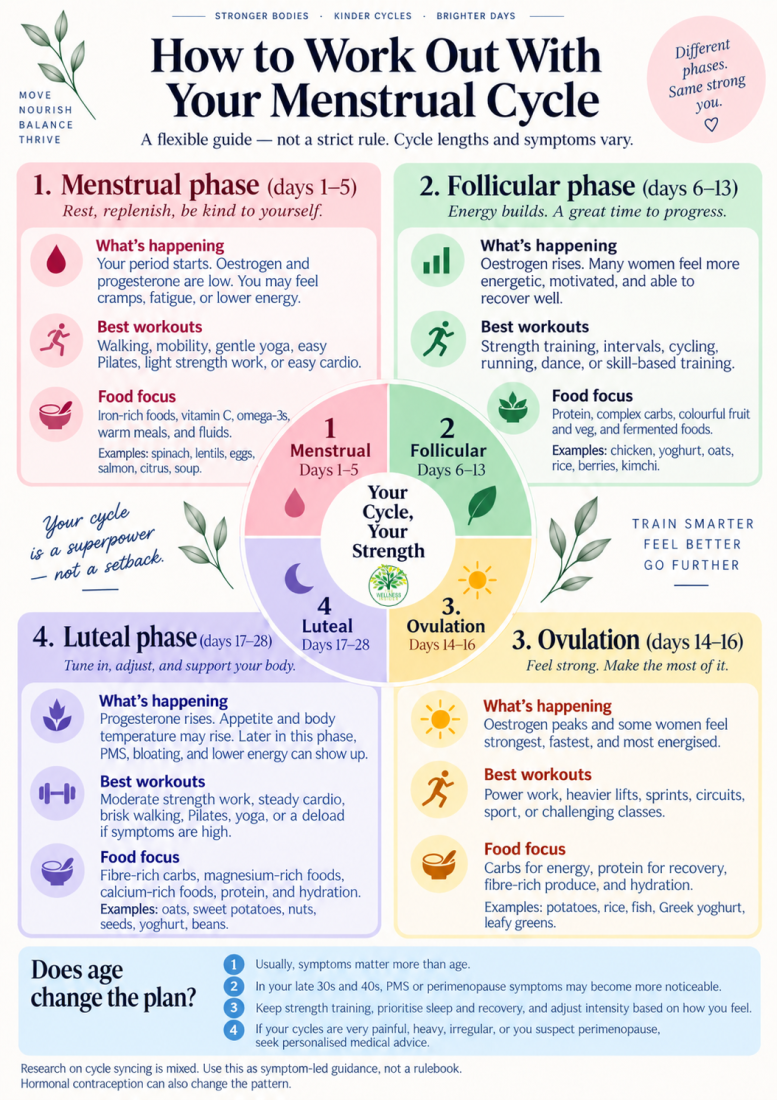
Your symptoms may matter more than the phase name
This is where lived experience and research can appear to conflict when they are actually asking different questions.
Population-level research asks whether women, on average, perform better or worse in a particular phase. An individual person may be asking something much simpler: “Why do my normal workouts feel awful for three days every month?”
A 2025 systematic review of female athletes’ experiences found that menstrual and hormonal-cycle-related symptoms could negatively affect participation, perceived performance and quality of life. Athletes described adapting training, competing through symptoms or concealing those symptoms in order to continue participating.
That is an important distinction. The menstrual phase itself may not determine performance, but symptoms associated with the cycle can still affect how someone trains.
If you experience severe cramps, migraine, heavy bleeding, gastrointestinal symptoms, poor sleep or marked fatigue, it is reasonable to modify the session. You do not need a cycle-syncing chart to justify doing so.
What I noticed about cravings, fatigue and the scale
One reason this subject interested me in the first place was that I had experienced the familiar combination of stronger cravings, feeling more tired during workouts and seeing the number on the scale move around my period.
At the time, I was following structured exercise and diet plans and had even worked with a personal trainer. When the usual routine suddenly felt harder, it was easy to interpret that as a lack of discipline.
That is not always a useful conclusion.
Changes in appetite, bloating, bowel habits and fluid retention can occur around the menstrual cycle. A temporary increase on the scale is not necessarily body-fat gain. Likewise, feeling more hungry for a few days does not mean that your overall nutrition plan has failed.
The practical lesson I would retain from the article that I found in 2020 is not that everyone needs a phase-specific diet. It is that understanding your own patterns can remove some unnecessary guilt.
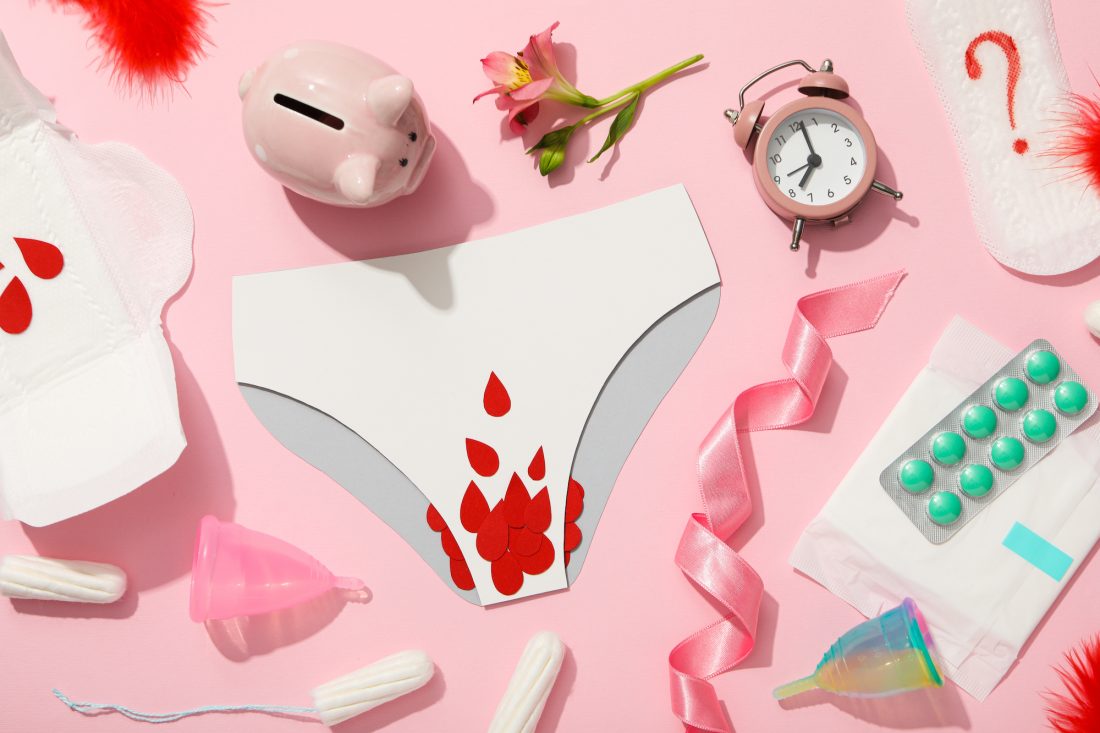
Menstrual health is also part of your health
When we first covered menstrual health on The Wellness Insider, we spoke with the founder of The Scarlet Company about improving menstrual health and later reviewed the Scarlet product.
Those earlier conversations were useful because they treated menstruation as something worth understanding rather than simply enduring.
That principle still holds. Tracking your cycle can be useful not because it tells you exactly which workout to do, but because it can help you recognise what is normal for you and what has changed.
This is also where femtech can be helpful. Period trackers and wearables can make it easier to notice recurring symptoms or performance patterns over several months. But the data is most useful when it helps you ask better questions, not when the app turns a population-level assumption into a personalised command.
What about very low body fat, missed periods and intense training?
There is another reason not to dismiss changes in the menstrual cycle as merely inconvenient.
In my book, Building Body Confidence, I included the first-hand experience of an athlete whose body fat became very low during competition preparation and whose menstrual function was affected.
We now have a more developed framework for understanding that issue.
The International Olympic Committee describes Relative Energy Deficiency in Sport (REDs) as a syndrome caused by problematic low energy availability, where dietary energy intake is insufficient relative to exercise expenditure. It can affect reproductive function, bone health, metabolism, immunity and performance, among other areas.
A missing or persistently irregular period in someone who is training hard or restricting food is therefore not something to celebrate as a sign of being “fit”. It can be a sign that the body does not have enough energy available to support normal physiological functions.
Should you change your workout during your period?
You can, but you do not automatically have to.
If you feel normal and want to follow your usual programme, current evidence does not suggest that menstruation itself requires you to stop strength training, running or doing high-intensity exercise.
If you are dealing with significant symptoms, adjusting the workout can be sensible. That might mean reducing load or volume, changing a hard interval session to steady movement, taking longer rests or choosing recovery instead.
The point is to respond to how you are actually feeling rather than following a rule that says everyone must train a certain way on Day 2 or Day 18.

A more useful way to track your cycle and training
If you are curious about whether your menstrual cycle affects your exercise, try tracking your own experience for a few months.
- Record the first day of your period and approximate cycle length.
- Note symptoms such as cramps, headaches, bloating, sleep disruption or unusually heavy bleeding.
- Track energy and perceived effort during workouts.
- Record objective measures that already exist in your programme, such as pace, weights lifted or repetitions, rather than creating extra tests just for your cycle.
- Look for repeated patterns over several cycles rather than drawing conclusions from one difficult workout.
You may discover a consistent pattern. You may discover very little difference at all.
Both are useful findings.
Hormonal contraception changes the picture
Another limitation of simplistic cycle-syncing advice is that it often assumes everyone has the same naturally occurring hormonal cycle.
People using hormonal contraception may have different hormone profiles, bleeding patterns and symptoms depending on the method they use. Someone approaching perimenopause may also experience increasingly irregular cycles and fluctuating symptoms.
This is another reason why broad prescriptions based only on calendar phases are unlikely to work equally well for everyone.
When to speak to a healthcare professional
Exercise should not require you to simply tolerate symptoms that are disrupting your life.
Speak to a healthcare professional if you have persistently absent or irregular periods, very heavy bleeding, severe pain, repeated dizziness or fainting, unexplained declines in performance, recurrent injuries or concerns that you are not eating enough to support your training. Very heavy bleeding can also increase the risk of iron deficiency, so if fatigue or dizziness is persistent, our guide on whether you need iron supplements explains what to consider before taking them.
Symptoms can have many causes and an app or training plan cannot diagnose them.
The goal is individualisation, not another set of rules
The fitness industry has historically treated male physiology as the default, so the growing interest in menstrual health and female-specific research is overdue.
But correcting that blind spot should not mean replacing one generic training template with another.
Current research does not give us a reliable universal programme for each menstrual phase. It does give us a better reason to pay attention to symptoms, energy availability and individual patterns.
If your cycle clearly affects how you feel, adapt where needed. If it does not, there is no need to manufacture a problem simply because an app says you have entered a different phase.
Your menstrual cycle can be useful information.
It does not have to become your workout schedule.
Sources: 2025 systematic review on menstrual-cycle phases and athletic performance; 2026 meta-analysis on menstrual-cycle phase and elite athlete performance; systematic review and meta-analysis of menstrual-cycle phase and exercise performance; umbrella review of menstrual-cycle phase and resistance exercise; 2025 systematic review of athletes’ menstrual and hormonal-cycle-related symptoms; IOC consensus statement on Relative Energy Deficiency in Sport.
Images: Envato


 Melissa Fann



 Shaameli Nadarajah

1 comment