The Dyson HushJet Purifier Compact HJ10 was provided by Dyson Singapore for review. Dyson had no editorial control over this article, and the opinions expressed are based on our experience using the product at home.
When the haze returned to Singapore, the timing of my Dyson HushJet Purifier Compact review could hardly have been more appropriate.
For several weeks, I used the HushJet in our combined living and dining area, while two other air purifiers continued operating in the bedrooms. This gave me an unexpectedly useful opportunity to see not just how the Dyson reacted to deteriorating outdoor air, but also how haze affects different parts of a home.
The biggest lesson was not simply that the HushJet can detect pollution. It was how difficult it can be to keep indoor air consistently clean when outdoor particulate levels remain elevated, and why choosing an air purifier based purely on price or the phrase “suitable for a small room” can be misleading.
What is the Dyson HushJet Purifier Compact?
The HushJet HJ10 is Dyson’s compact dedicated air purifier, currently retailing in Singapore at S$499.
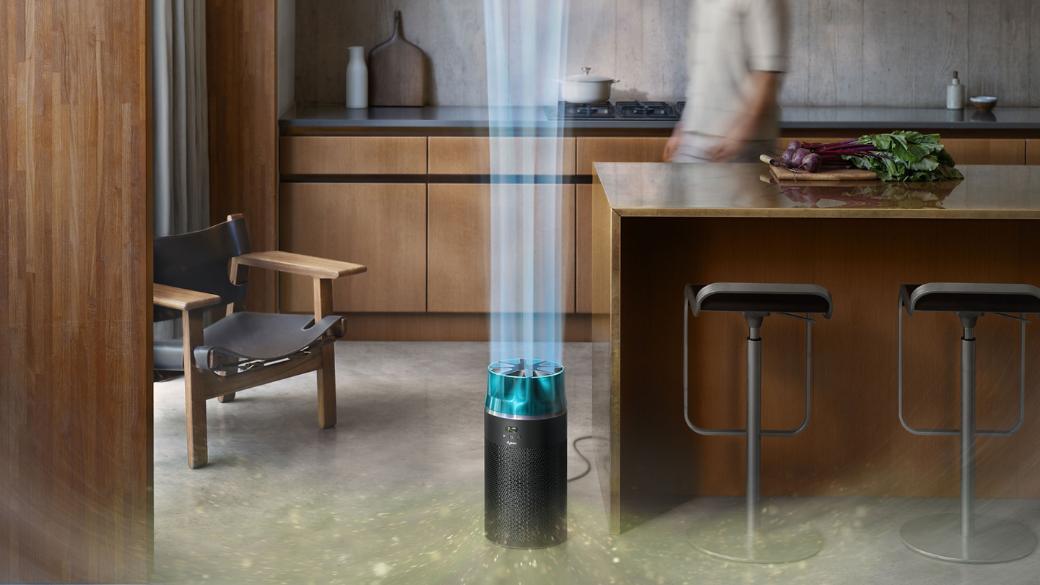
Despite its relatively small footprint, Dyson says it is engineered to purify rooms of up to 100m², with airflow of up to 70 litres per second and a projected airflow distance of up to nine metres. Its filtration system captures 99.97% of particles as small as 0.3 microns, according to Dyson, and its filter is designed to last for up to five years. You can view the official HushJet specifications here. It also connects to the MyDyson app, allowing users to monitor indoor air quality, control the purifier remotely and create operating schedules.
Dyson describes the HushJet as a DC-powered fan or air circulator with purification, although in practice I found it more useful to think of it as a dedicated purifier that also projects noticeable airflow.
Setting it up was almost effortless
My first impression was how little effort the HushJet required to get running.
I downloaded the MyDyson app, created an account, plugged the purifier in and switched it on. Creating the account was honestly the most tedious part of the process; connecting the machine itself was straightforward. I was equally impressed by the warranty registration.
Rather than having to search the appliance or packaging for a serial number and type it into another form, the app connected to the HushJet via Bluetooth, identified the machine and its serial number, and I simply entered the purchase date. These are small things, but they matter. Smart appliances often introduce additional setup rather than removing it. Here, Dyson has largely succeeded in making the initial ownership experience feel uncomplicated.
The haze gave the Auto mode a real workout
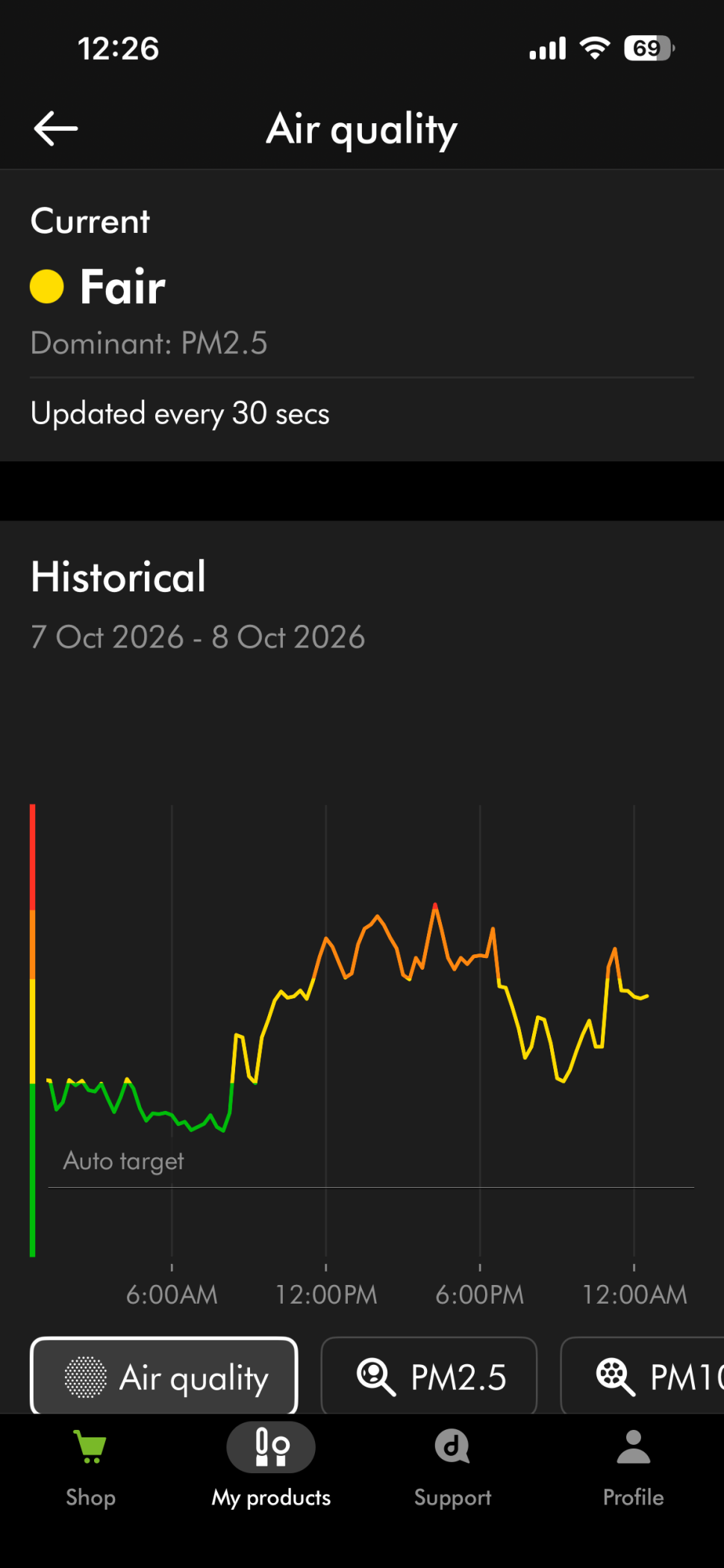
Because the haze was already affecting Singapore when I began testing the HushJet, the purifier quickly registered the indoor air quality in our living and dining area as “Fair”.
I left it predominantly in Auto mode, and during some of the poorer haze periods it spent a surprising amount of time working quite hard. The response was particularly obvious whenever we opened our front door, even briefly to water the plants or leave the house. The purifier would increase its output soon afterwards.
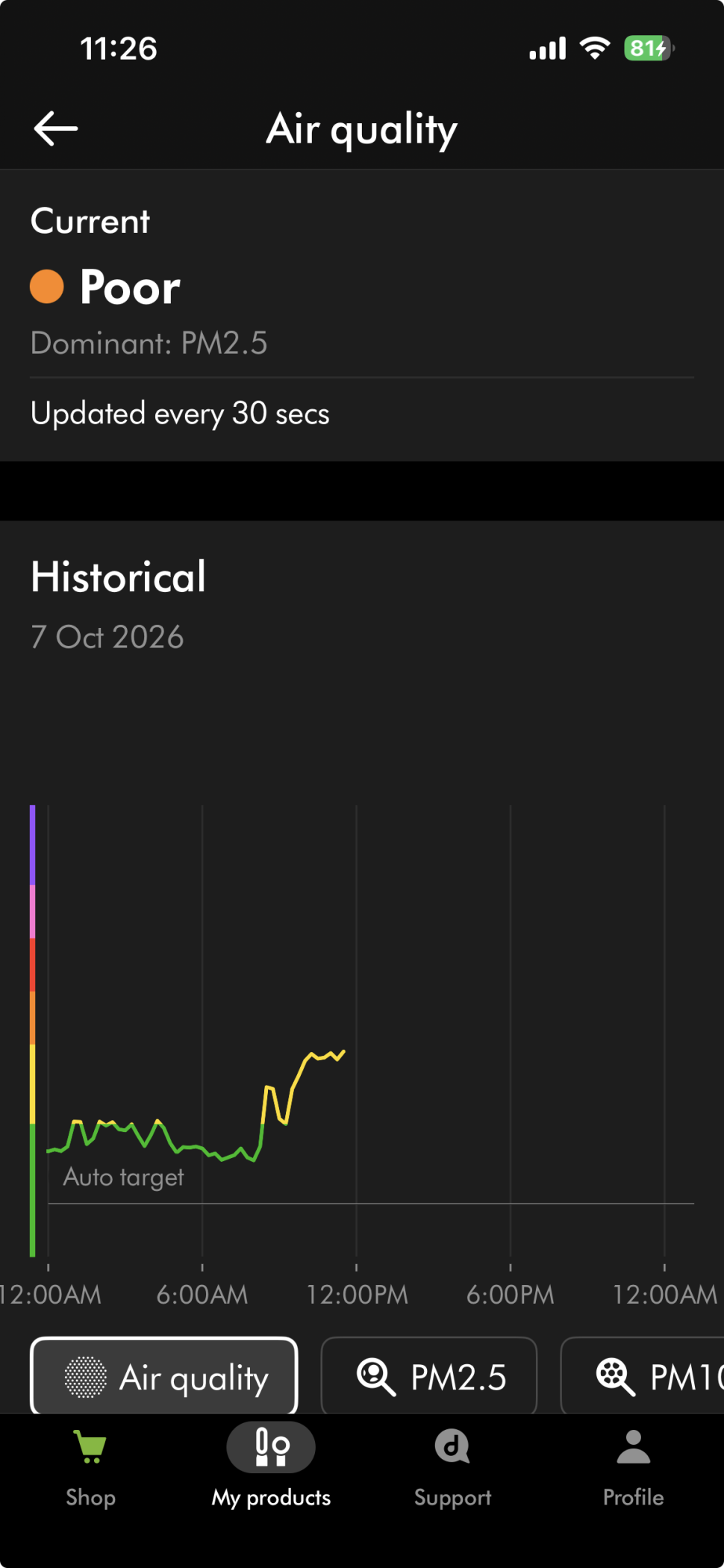
At one point, the MyDyson app showed PM2.5 as the dominant pollutant and rated the indoor air as “Poor”. Despite the purifier running in Auto mode, the reading remained above Dyson’s target range for several hours before eventually improving to “Fair”.
That is an important distinction.
The purifier was clearly detecting changes in the air and responding to them, but that does not mean it could instantly overcome sustained particulate pollution entering the home.
During prolonged haze, purification is not necessarily a matter of switching a machine on and watching the indicator immediately turn green.
Although the readings occasionally dropped lower overnight, the more revealing pattern was what happened during the day: as haze conditions intensified again, PM2.5 levels would rise and the purifier would ramp up once more.
On 14 October, shortly after my husband came home and the front door was opened, the indoor air-quality reading spiked to “Very Poor”. I had already noticed throughout the review that opening the front door during the haze often caused the purifier to react quickly, so this was another example of how sensitive the HushJet was to sudden changes in indoor air quality.
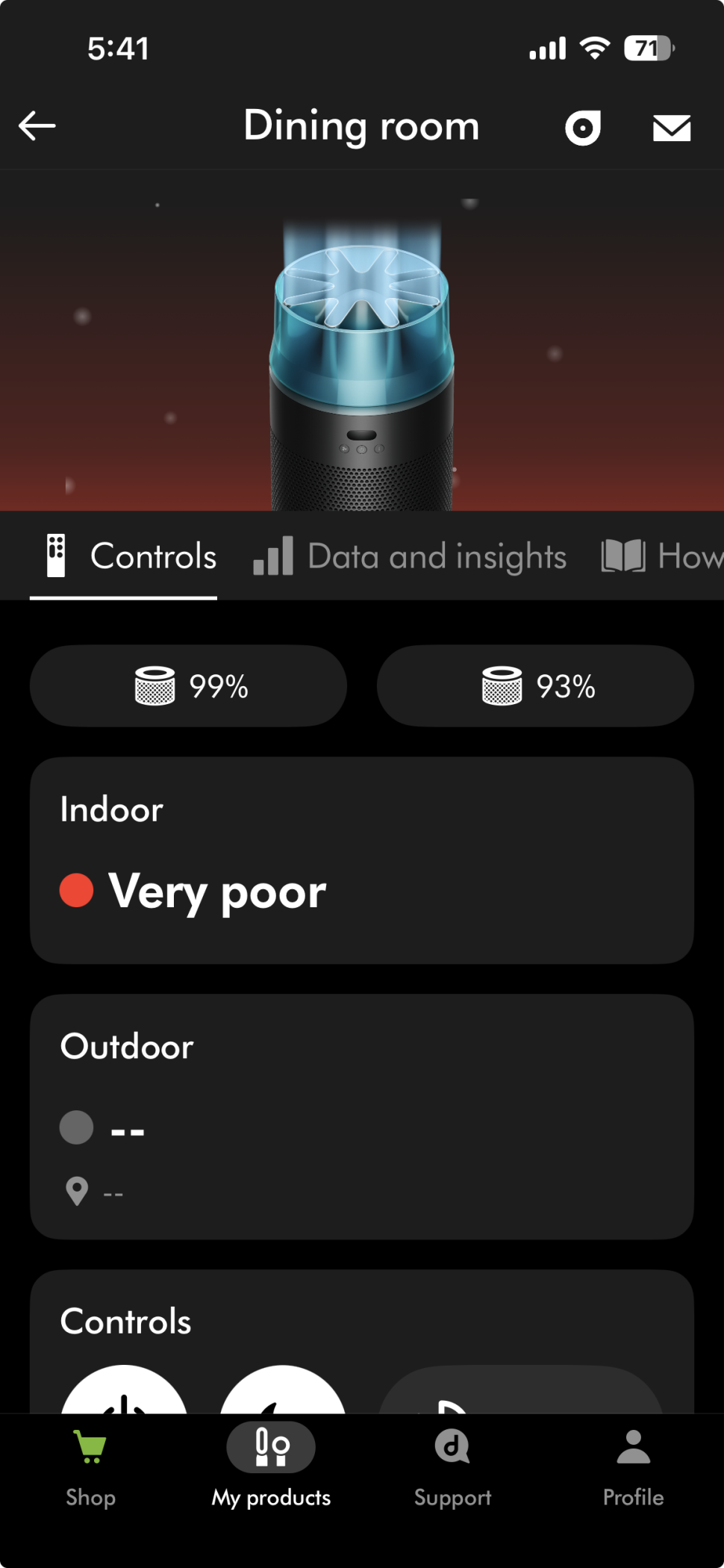
At the same time, the app showed the carbon filter at 93% remaining after roughly two weeks of heavy use, while the other filter indicator remained at 99%. I would not assume that the filter will continue declining at the same rate, but it is a useful reminder that sustained haze conditions may increase how hard the filtration system has to work.
For more context on how haze affects indoor air and what households can do, see our guide on how to protect your health and improve indoor air quality during haze. If the haze is already leaving you with a dry throat, cough, irritated eyes or other mild symptoms, the same guide also covers what you can do to ease haze-related discomfort and when to seek medical attention.
Poor outdoor air really does find its way indoors
Perhaps the more interesting observation came from comparing different parts of our home.
We have three air purifiers: two in bedrooms and the HushJet in the common living and dining area. One of our bedroom purifiers was recording the same “Fair” air quality as the Dyson even though the bedroom was air-conditioned. The smell inside our home was noticeably different from the smoky smell outdoors, so having the purifiers running certainly made the indoor environment more comfortable.
But the readings were also a reminder that closing the doors and windows does not create a completely isolated bubble. Fine particles can still enter a home through doors, gaps and normal movement in and out of the flat. It also made me question something that probably does not receive enough attention: how many air purifiers does a household actually need?
One purifier for the whole house?
There is no particularly useful answer such as “one purifier per household” or “one purifier per bedroom”.
What matters more is the size of the area being cleaned and whether air can move effectively between rooms. A purifier positioned in a living room cannot necessarily clean the air inside a closed bedroom, no matter how powerful it is. Conversely, households with relatively open layouts may be able to cover several connected areas with one appropriately sized machine. This is why consumers should pay much more attention to the manufacturer’s stated room coverage and performance than labels such as “small room”.
I learnt this from an earlier purifier I reviewed. At first, I felt that its performance did not seem to match the purifier I normally used in my bedroom. I later discovered that the unit had actually been designed for a space smaller than a typical HDB bedroom. My immediate reaction was: why wasn’t that information made clearer either on the box or on the manual?
Calling something suitable for a “small room” is subjective. Showing consumers the intended room size in square metres gives them something they can actually compare with their home. But of course, it also means that you need to know how large your rooms are, which isn’t something that most of us bother to remember. Even then, coverage figures should not be treated as guarantees. Actual performance depends on factors including the layout, pollutant load, airflow and how often outdoor air enters the room.
The HushJet is compact, but I was pushing it
Dyson states that the HushJet can purify a room of up to 100m², an unusually large claimed coverage area for a machine this compact.
Our living and dining area certainly comes nowhere close to that size, yet during periods of persistent haze I still felt that I was giving the machine a fairly demanding job. That does not necessarily mean it was underpowered. The HushJet continued detecting changes and responding to them. Rather, the experience demonstrated how different real-world conditions can be from a simple room-size specification. If PM2.5 is continually entering the home every time doors open, the purifier is not cleaning a fixed amount of polluted air once. It is dealing with an ongoing source. Hence, for its physical size, I found the HushJet impressively capable.
Does the HushJet work as a fan?
This was an area where my opinion changed after living with it for longer.
On the first day, I noticed enough airflow that I did not feel much need to switch on our usual fan. Sitting close to the HushJet, you can certainly feel air being projected from it and that was enough to cool me down. My husband disagreed that the dining room itself felt cooler, however, and after several weeks I agree with him.
There is airflow, and sitting beside it can feel similar to having a fan directed towards you. But I did not notice a meaningful reduction in the temperature or the kind of whole-room circulation that our conventional fan produces. If you specifically want a purifier that also functions as a stronger room fan, a dedicated purifier-fan model may be more appropriate. The HushJet is better thought of as a powerful purifier that happens to project noticeable airflow.
It reacts to more than just haze
The haze was not the only thing that made the HushJet spring into action.
I use a humidifier with essential oils in the bedroom, and even though the Dyson was in the living and dining area, when we opened the bedroom door, it detected the change relatively quickly. Its reading changed from “Good” to “Fair” and the fan speed increased. I had previously seen similar behaviour with another air purifier, so I would not describe this as a unique Dyson capability. Nor does the reading mean that using essential oils automatically made the air dangerous. What it demonstrated was that the HushJet’s sensors were responsive to changes occurring elsewhere in our home. Cooking produced similar reactions.
That is also why I disagree with the idea that an air purifier is useful only when Singapore experiences haze. Everyday indoor air changes because of cooking, fragrances, cleaning products, dust and pollutants entering from outdoors. We have previously written about why an air purifier can be useful beyond haze season, and this review reinforced that point.
One scheduling feature I found unintuitive
The MyDyson app has generally been easy to use, but its scheduling logic caught me out.
I initially created a schedule that put the purifier into Night Mode from 9pm until 8am. I assumed that when Night Mode ended at 8am, the machine would return to its previous Auto setting. Instead, it switched itself off completely.
I initially thought this was a software problem, so I deleted the schedule and tried again.
This time, I scheduled Night Mode between 8pm and midnight. The same thing happened. I contacted Dyson, which confirmed that this is intentional behaviour. When a scheduled period ends, the machine stops operating. If you want it to continue in Auto or another mode afterwards, you must create another schedule beginning at the first schedule’s end time.
Technically, therefore, the feature was functioning correctly. I still don’t find the behaviour intuitive. If I tell an appliance to use Night Mode between two times, I would naturally expect it to stop using Night Mode afterwards, not stop purifying altogether. It matters because an air purifier is the kind of appliance most people want running unobtrusively in the background. On the first occasions this happened, I did not immediately realise that the machine had turned itself off.
Dyson’s implementation works once you understand it, but the app could make this logic much clearer.
The Climate Vouchers change the affordability equation
At S$499, the HushJet is not an insignificant purchase.
However, Singapore’s Climate Friendly Households Programme makes the price considerably more interesting. Eligible households can receive up to S$400 in Climate Vouchers, valid until 31 December 2027. The HushJet is eligible under the programme, and participating Dyson outlets accept Climate Vouchers. You can check the latest eligibility and programme details on the National Environment Agency website. Assuming a household still has the full S$400 available and uses it towards a HushJet at its current S$499 retail price, that leaves an out-of-pocket cost of approximately S$99.
That changes how I would evaluate it. Rather than asking whether someone should spend nearly S$500 on an air purifier, the more useful question becomes whether this is a good use of S$400 in vouchers. For someone who already wants an air purifier, I would rather use the subsidy towards a machine with substantial stated room coverage than spend a similar amount of my own cash on a cheaper purifier only to discover later that it was designed for a much smaller room.
That does not mean buying the biggest or most expensive purifier available. The machine still needs to suit your home. But the vouchers make it possible to prioritise performance and coverage rather than making the decision almost entirely around upfront price.
What I liked and what I didn’t
After several weeks with the HushJet, the things I appreciated most were its compact size, easy setup, responsive Auto mode, useful air-quality information and surprisingly substantial purification capability for such a small machine.
The five-year claimed filter lifespan is potentially important too. Longer filter replacement intervals could make its ongoing ownership cost more attractive, although actual filter life will naturally depend on usage and conditions. Its weaknesses are subtler.
The airflow should not be mistaken for whole-room cooling. The scheduling system is unnecessarily unintuitive.
There is also the question of noise. My husband found the HushJet noticeably noisy when it was working hard outside Night Mode. During periods when the indoor air was rated Fair, Poor or Very Poor, the purifier could stay at a higher fan speed for extended periods, which made its presence much more noticeable. And during severe or prolonged haze, even a purifier with impressive stated coverage may spend hours working hard without keeping indoor PM2.5 consistently within its preferred range. None of those issues makes the machine ineffective.
They simply matter when deciding what you expect an air purifier to do.
So, is the Dyson HushJet worth it?
At the full S$499 price, I would consider the HushJet a premium compact air purifier and would compare it carefully with alternatives before buying.
At an effective cash outlay of around S$99 after S$400 in available Climate Vouchers, however, the proposition looks very different. What impressed me most was not that the HushJet magically made the effects of Singapore’s haze disappear. It didn’t.
It was that such a small appliance could sit unobtrusively in our living and dining area, continuously monitor the air and react noticeably whenever conditions changed. The persistent haze also reinforced something I have learnt from reviewing several purifiers: choosing the right machine is not simply about buying “an air purifier”.
You need to know how large a space it is actually designed to handle. For Singapore households considering using their Climate Vouchers on one, that may be the most important specification to check. You may also be interested in our earlier review asking whether we had found the best air purifier with Aura Air, as well as our report on Dyson data showing Singapore ranked fourth globally for poorest indoor air quality.
Images: Dyson Singapore and screenshots by Melissa Fann for The Wellness Insider


 Melissa Fann


 Trevor Klass