
What makes someone choose one destination over another?
Sometimes, it is not really the destination at all.
It might be a Formula 1 race, a concert by a favourite artist, the chance to see snow for the first time or, at the opposite extreme, the promise of several days away from screens, crowds and constant notifications.
Recent data across Asia Pacific suggests that the experience people want from a holiday may increasingly influence where they travel, how long they stay and even whether they return. At the same time, those experiences can look remarkably different — from packed grandstands and arena concerts to hot springs and digital detoxes.
The common thread may be less about where we go, and more about what we want travel to give us.

When an event becomes the reason for the trip
This October offers an unusual example.
The Formula 1 Gulf Air Bahrain Grand Prix will take place at Malaysia’s Sepang International Circuit from 2 to 4 October, followed by the Singapore Grand Prix from 9 to 11 October. New Amadeus Travel Intelligence data shows rising travel demand around both race periods, including cross-border movement between Malaysia and Singapore.
Air arrivals from Kuala Lumpur to Singapore between the two races are up 74% year-on-year, according to Amadeus.
The increase is not limited to neighbouring travellers. During the Malaysian race week, the fastest-growing international source markets for arrivals into Kuala Lumpur include the UK, up 49% year-on-year, Australia, up 40%, and Singapore, up 38%.
Ahead of the Singapore race, international air arrivals from the US are up 88% year-on-year, followed by the UK at 73%, New Zealand at 54% and Taiwan at 43%.
That does not mean Formula 1 alone caused those increases. Amadeus notes that its figures show observed travel demand during the relevant periods and do not attribute every booking or change in travel behaviour to a particular event.
What is more interesting is what travellers appear to be doing with their time once they arrive.
In Kuala Lumpur, short stays of one to five nights are up 17% year-on-year around the race period. Singapore, meanwhile, is seeing a 49% increase in stays of six to 13 nights.
For some visitors, then, the race weekend may be becoming an anchor around which a longer Southeast Asian holiday is built.
A concert ticket can become a holiday too
Live music appears to be having a similar effect.
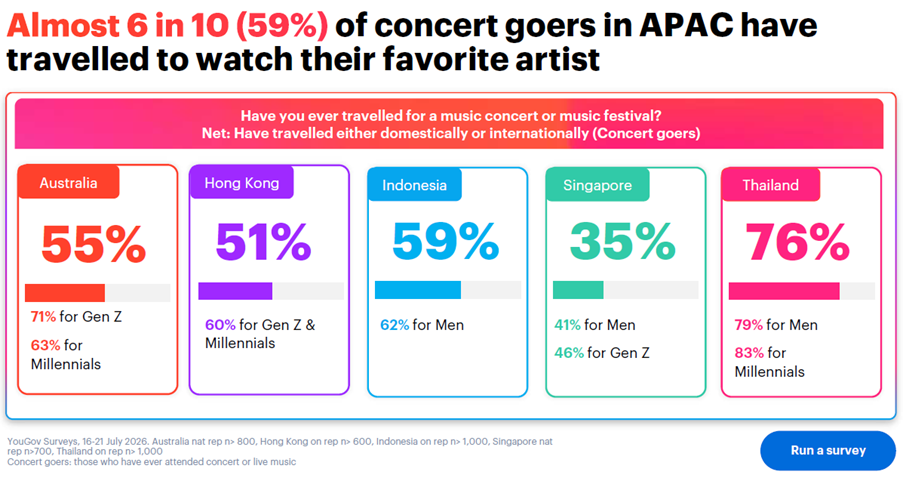
YouGov’s Following the Music: APAC Concert Goers Report 2026 surveyed more than 7,200 adults across Australia, Hong Kong, Indonesia, Singapore and Thailand. Its concert-goer findings refer to people who have ever attended a concert or live music event.
Among those concert goers, 59% said they had travelled specifically to see an artist perform. In Thailand, that figure rises to 76%.
The influence can extend beyond the show itself. More than half of concert goers surveyed — 54% — said attending a concert made them more interested in the city hosting it. The proportion reaches 71% in Thailand.
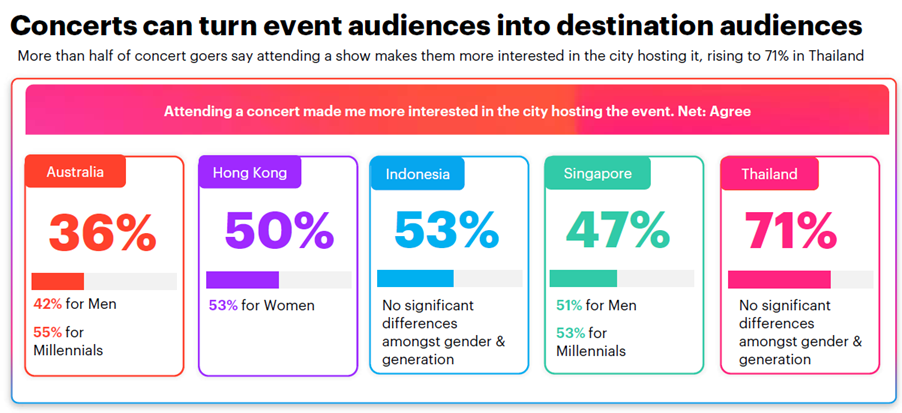
Concert travellers are not necessarily arriving just in time for the opening act and leaving the following morning. A majority said they extend their visit by another two to three days to explore the destination.
Singapore stands out here: 59% of Singapore concert travellers said they add extra time specifically to see the city, with sightseeing the most common activity during the extension, followed by dining and shopping.
There are signs that an event can influence future travel too. In Thailand, 22% of concert goers said a show introduced them to a destination they had subsequently returned to, while 49% said they intended to return. Among Indonesian concert goers who discovered somewhere new through a concert, half said they planned to visit it again.
Together with the Formula 1 data, the findings suggest an event can act as more than entertainment. It can give someone a reason to visit a city they might otherwise have overlooked — and potentially encourage them to stay longer or return later.

Experience-led travel still has a price ceiling
There is an important qualifier.
Wanting to fly somewhere for a race or concert is not the same as being able to afford it.
YouGov found that ticket prices and overall costs remain the biggest barriers to concert attendance, with the problem particularly pronounced among respondents in Singapore and Australia.
A trip built around an event can involve far more than the admission price: flights, accommodation, transport, meals and additional days away from work all add to the bill.
That makes experience-led travel vulnerable to the same cost pressures affecting leisure travel generally. A destination may be highly desirable, but there is still a point at which the experience stops feeling worth the expense.
Sometimes the season itself is the experience
An event does not always need a starting time and a ticket.
For travellers from tropical countries, simply experiencing a very different climate can become part of the appeal.
Visa’s analysis of Singapore residents’ December 2025 spending found that Japan was their second-largest year-end travel corridor after Malaysia. More strikingly, card spending in traditionally wintry parts of the country rose substantially: 28% year-on-year in Hokkaido and 26% in Nagano.
Snow, skiing, outdoor hot springs and winter itself can therefore become reasons to travel. This also sits alongside the broader appeal of cooler destinations and off-peak holidays among Singapore travellers.
They create a practical challenge for people whose wardrobes were designed for Singapore’s heat.
Winter Time is responding to that demand with its Winter Wear & Luggage Expo at Singapore EXPO. After its first September edition, the remaining sales run from 24 to 27 September, 1 to 4 October, and 28 October to 1 November 2026.

But preparing properly for winter should not simply mean buying the thickest coat available.
How long someone will spend outdoors, the expected temperature, wind, rain or snow, and the activities planned all matter. Layering also allows travellers to adapt as they move between heated indoor environments and colder outdoor conditions.
There is a consumption question here too.
Someone spending ten days in Hokkaido does not necessarily need an entirely new winter wardrobe that will then remain untouched in a Singapore cupboard. Borrowing suitable items, re-wearing pieces across multiple trips and choosing versatile layers can make more sense than buying heavily for a single holiday.
At the other extreme, some travellers want less
If F1 races and concerts represent holidays built around stimulation, another kind of travel is selling almost the exact opposite.
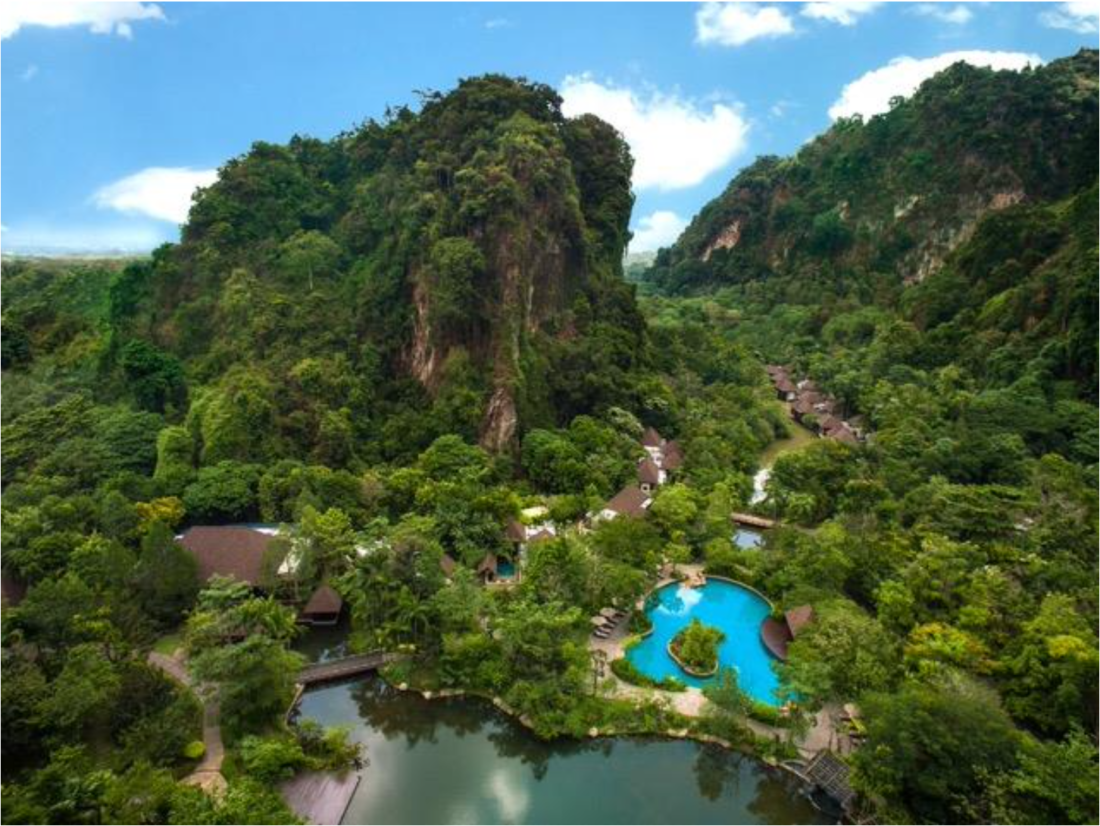
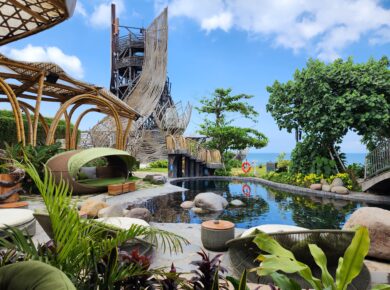
The Banjaran Hotsprings Retreat in Ipoh, Malaysia calls its approach “hushpitality”: escaping the noise of an always-connected lifestyle through quiet, nature and deliberate digital disconnection.
The adults-only retreat sits in a 22.7-acre valley surrounded by rainforest, limestone formations, natural hot springs and caves.
“Hushpitality” is the retreat’s own framing rather than evidence of a formally established global travel category. But the underlying idea is recognisable.
Instead of moving from attraction to attraction, a day might involve sunrise yoga, breathwork, qi gong or tai chi. Guests can use meditation caves, thermal steam baths and hot springs, walk through the jungle or simply spend time doing very little.
For travellers looking for a more structured reset, The Banjaran also offers wellness programmes lasting from four to 22 days, covering areas including detox, fitness, longevity and rejuvenation.
On paper, it could hardly sound more different from flying across Asia to spend a weekend surrounded by roaring engines or thousands of concert fans.
Yet the motivation may not be entirely different.

The common thread may be contrast
An F1 weekend is loud, crowded and highly stimulating. A quiet retreat is deliberately slow and pared back.
But both can begin with the same decision: I want my holiday to feel different from my everyday life.
For someone whose normal week revolves around work, routine and predictability, that may mean grandstands, a new city and thousands of other fans.
For someone whose days are filled with meetings, screens and constant notifications, luxury might mean being somewhere nobody expects an immediate reply.
A winter holiday offers another type of contrast. Travellers who live with tropical weather year-round can walk through snow, ski, soak in an outdoor onsen in the cold or simply experience what it feels like to need three layers before leaving the hotel.
Perhaps that is why “Where should I go?” is becoming less useful as the first question when planning a holiday.
A better starting point may be: What am I actually hoping to get out of going away?
Travelling deliberately does not mean doing more
That question can also prevent a common problem: packing a holiday so full of supposedly unmissable experiences that we return home needing another break.
If the purpose is excitement, build around the event and leave enough time to experience the destination around it. If it is rest, resist the urge to justify the airfare by filling every available hour. If it is time with family or a partner, consider whether everyone actually wants the same kind of holiday.
There is no inherently healthier way to travel. Seven days at a wellness retreat can become another optimisation project, just as an action-packed city break can be exactly the mental reset somebody needs.
The more useful distinction may be between travelling deliberately and simply collecting destinations, activities and photographs because we think that is what a holiday is supposed to look like.
In 2026, the experiences drawing travellers can look remarkably different — from the roar of Formula 1 engines to the sound of almost nothing at all.
Images: Envato, The Banjaran Hotsprings Retreat, Winter Times

 Melissa Fann
 Luke Elijah